![New Industry Creation Hatchery Center[NICHe]](../img/common/niche_en.svg)
Research and Development of Tough Robotics and AI Technologies for Real-World Applications
 ProfessorKazunori Ohno
Research Overview
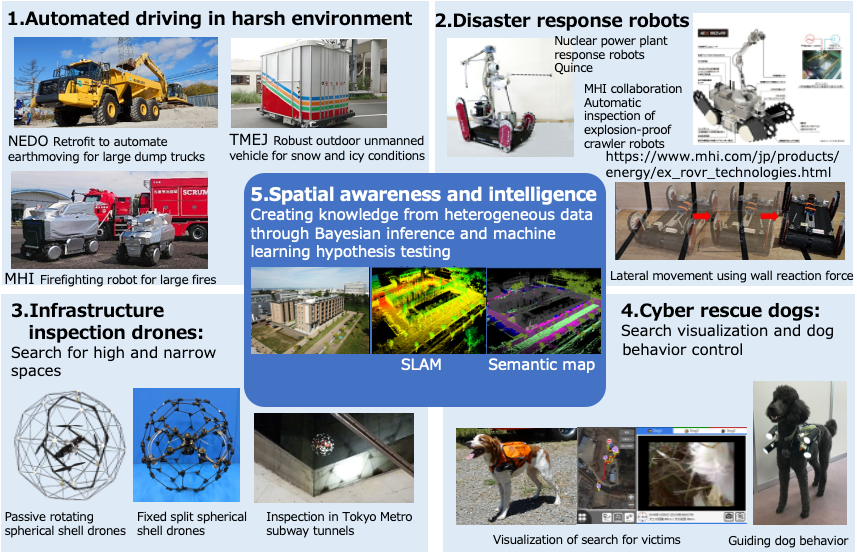
Labor shortages due to declining birthrate and aging population have become a major social issue. In addition, the suppression of human movement due to the spread of infectious diseases is escalating the problem of labor shortages. We are working to solve this social problem through research and development of tough robotics and AI technologies. Our tough robotics and AI technologies include the development of robots that can work in harsh and confined environments for disaster response and infrastructure inspection, the development of intelligence to revolutionize civil engineering and construction, custom manufacturing, automated vehicle driving, and sensing methods that understand the intentions and emotions of people and pets.
Research Features
- Development of robot technology based on new ideas: simple and effective robotics for increasing productivity in many situations based on the flexible ideas and expertise of the university.
- Robust recognition and control using probabilistic methods: recognition of noise, bad weather, dust, and disturbances caused by surrounding humans, that allow robotics to understand the environment and act accordingly.
- Data-based knowledge enhancement: systems to understand the local rules that exist in each situation where humans and robots coexist, based on the robot's sensor data, and to perform actions that are appropriate to the situation.
- Non-invasive sensing to recognize emotional states of humans and animals: understanding of the emotional states of humans and animals through non-verbal communication (e.g., electrocardiogram, respiration, and social signals).
Expected Outcomes and Developments
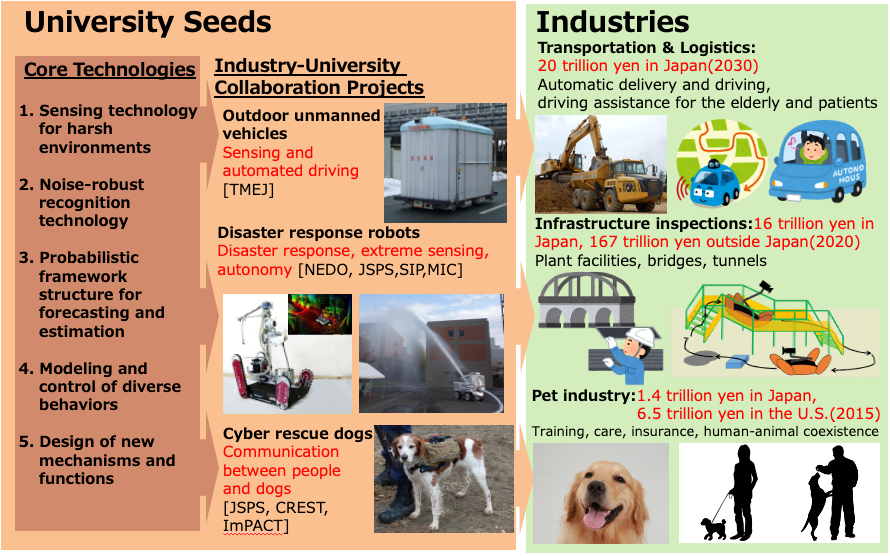
Expected social outcomes are the dissemination of technology through social implementation of tough robotics and AI technologies in fields such as transportation and logistics, disaster response and infrastructure inspection, and the pet industry, as well as the discovery of new research issues. We welcome companies and local governments facing problems in their fields to reach out to us and discuss their real problems with us to develop solutions through consultations and action.
Expected academic outcomes include the penetration of the research field of data engineering robotics, where people involved in robotics and information create knowledge-based systems that use probabilistic methods and sensor data that will create a new research field called artificial homeostasis. In artificial homeostasis, people involved in robotics, information and civil engineering use their abilities collectively to construct artificial objects that are self-nurtured. We aim to create a new research field called “Canine Super Sensing”, which brings together people involved in robotics, information, and animal behavior together to create sub-systems that grow by themselves. We would like to welcome cooperation with researchers and engineers in our developmental efforts.