![New Industry Creation Hatchery Center[NICHe]](../img/common/niche_en.svg)
Molecular Interface Engineering
 Senior Research FellowKazue Kurihara
Research Overview
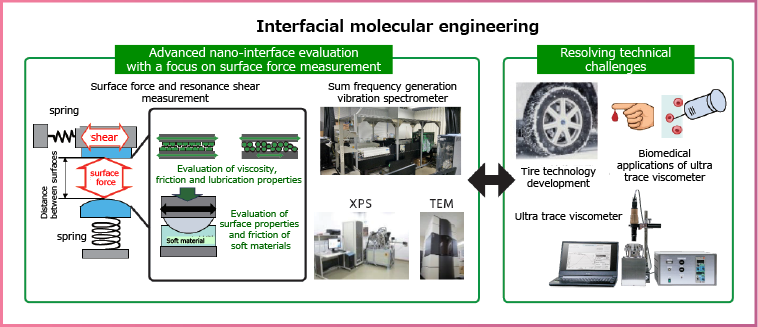
By leveraging world-leading nano-interface characterization technologies rooted in surface force measurement, our team has pioneered "friction fusion research." Our track record includes the commercialization of the world's smallest-volume ultra-trace viscometer and the development of practical storage batteries through electrode interface film characterization. This project aims to further advance measurement methods for interfacial molecular engineering, driving social implementation through product development and providing decisive solutions to industrial challenges.
Research Features
This project develops cutting-edge nano-interface characterization technologies to address complex industrial issues. Our unique approach combines various characterization methods to elucidate the macroscopic, real-world material interfaces at the molecular level-bridging the gap where conventional nano-scale evaluations often fall short. The core tool, surface force measurement, effectively links macro- and nano-scale phenomena by measuring interactions between surfaces on a micron scale with nanometer-distance resolution. Our primary focus is on friction, lubrication, and storage battery materials, all of which are critical for solving environmental and energy issues.
Expected Outcomes and Developments
- Development and Application of Ultra-trace Rheometers: By advancing ultra-trace rheometer technology and expanding into fields such as biomedicine, we will enable viscosity measurements in previously inaccessible areas, bringing innovation to analytical methodology.
- Research on Ice-Rubber Friction: Utilizing the world’s only surface force and resonance shear measurement system capable of operating below -20°C, we systematically evaluate factors governing ice-rubber friction. In collaboration with Keio University (MD simulation/machine learning) and the University of Lyon (macro-friction evaluation), we propose design guidelines for high-performance winter tires and work with industry partners for practical implementation.
- Comprehensive Battery Evaluation: We develop original approaches to solve technical bottlenecks based on our proprietary interface characterization technology, contributing to the advancement of next-generation storage batteries through strategic joint research.
Interfacial molecular engineering