![New Industry Creation Hatchery Center[NICHe]](../img/common/niche_en.svg)
Super-Large-Scale Computational Science Simulations for Industrial Development
 ProfessorMomoji Kubo
Research Overview
Development of advanced materials design technology based on theory is necessary to address many of the world's energy issues for which urgent measures must be implemented to realize a safe and secure society. Because the number of elements in the periodic table is limited, this project has set “element-independent materials design” as its strategic goal, and aims to be the first in the world to develop super-large-scale computational simulation technology and to realize the theoretical design of complex composite materials consist of multiple components such as metals, ceramics, polymers, and carbon materials.
Research Features
This project will develop super-large-scale computational simulation technology in the scope of two scenarios. Scenario (1): multi-scale computational science with millions to hundreds of millions of atoms, which enables us to elucidate the effects of nanoscale "chemical reactions" on macro-scale "functions and properties", "material degradation, wear, corrosion and fracture phenomena", and "synthesis and processing processes". Scenario (2):multi-physics computational science simulation technology, which enables us to reveal the complex phenomena involving “friction, impact, stress, fluid, electron, heat, light, electric field” along with “chemical reactions”. In addition, by applying these technologies to specific industrial problems such as fuel cells, tribology, and structural materials, we aim to realize industrial innovation by the super-large-scale computational science simulations.
Expected Outcomes and Developments
This project aims to improve the essential “quality of computational science”, rather than simply increasing the “size of computational simulation”, through super-large-scale computational science simulations. For example, in the fuel cell field, instead of designing additive elements in catalysts, which has been the target of conventional computational science, we will be able to design the three-dimensional structure of catalyst layers, thereby realizing "element-independent material design”. In the field of tribology, we will enable a paradigm shift from the elucidation of “friction phenomena” based on small-scale calculations to the elucidation of “wear phenomena,” which will become possible only through super-large-scale calculations. In the field of structural materials, we will realize the game change from the simulation of “crack propagation”, which has been the target of traditional computational science, to the elucidation of the effects of “nano-scale chemical reactions” on “macro-scale corrosion phenomena”. The innovations brought about by these super-large-scale computational sciences aim to bring about new industrial development and advancement.
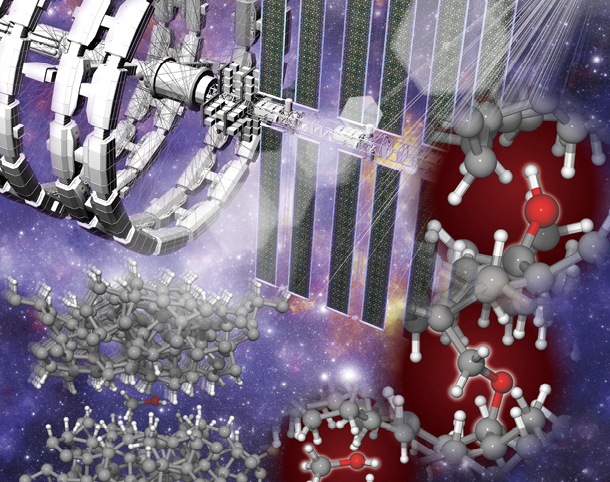
Multi-scale simulation of space equipment
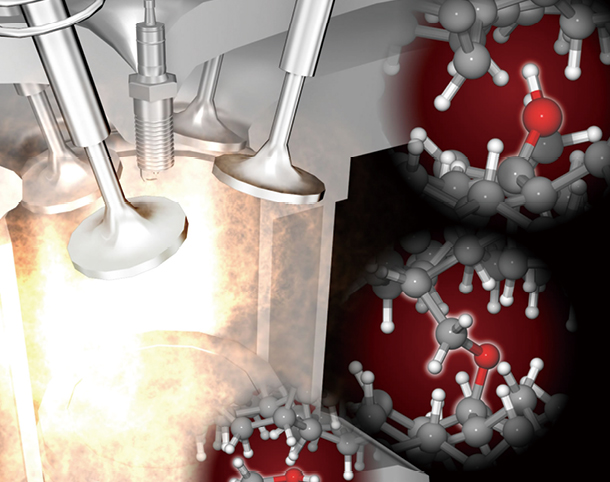
Multi-scale simulation of engine lubricants

Multi-scale simulation of solar cells