![New Industry Creation Hatchery Center[NICHe]](../img/common/niche_en.svg)
Joint Research Project on Interconnect Advanced Technology
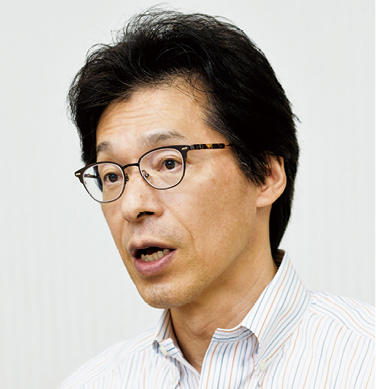 Specially Appointed ProfessorJunichi Koike
Research Overview
In advanced semiconductor devices, interconnects experience a sharp increase in electrical resistivity and current density as device dimensions continue to shrink. This degradation in performance and reliability poses a critical challenge. To date, no interconnect material is available that can fully overcome these issues. This project addresses interconnect-related challenges by developing new materials with superior performance and reliability, specifically targeting technologies beyond the 2-nm scale.
Research Features
Accurate information about the materials and manufacturing processes used in cutting-edge semiconductor devices is rarely disclosed, making it difficult to identify important technical issues in industry. This research enables us to identify potential challenges and provide timely solutions through joint projects with partners across the supply chain and in close collaboration with device manufacturers.
The scientific foundation of this work lies in metallurgical engineering. We use thermodynamic calculations and quantum mechanical calculations to select candidate materials and predict their reaction behavior, which is then validated experimentally.
Expected Outcomes and Developments
Next-generation semiconductor devices are key enablers of transformative technologies such as autonomous driving and advanced generative AI. However, interconnect limitations have become a major bottleneck to further progress. For nearly 30 years, aluminum wiring was the interconnect standard, later replaced by copper. Yet as devices continue to scale down, even copper’s intrinsic properties are proving insufficient, raising concerns about both performance and reliability.
The new materials under investigation in this project are expected to overcome these limitations, offering the potential to serve as the successor to copper interconnect and to remain viable in the future. Ultimately, the technologies developed here will help usher in a new era of information innovation.
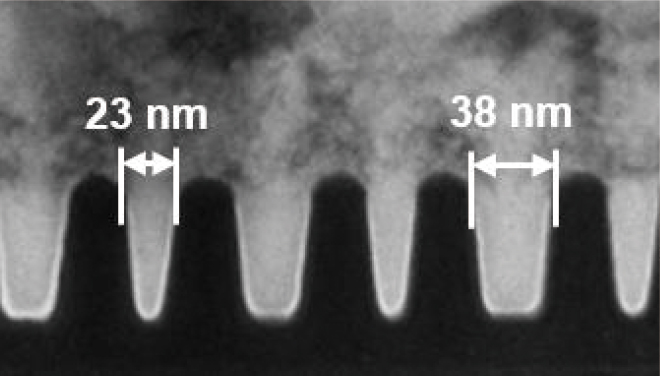
Formation of CuAl2 lines by dynamic reflow method. Cu and Al were sputter deposited onto a heated substrate to 250 ℃.
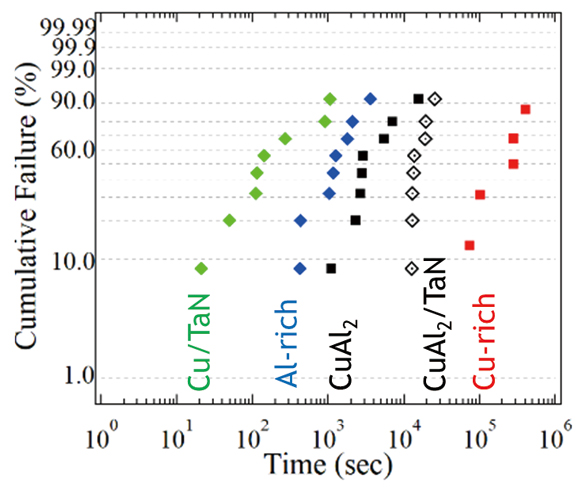
Comparison of electromigration lifetime between conventional Cu (Cu/TaN) and advanced interconnect materials. Lifetime of the new material is 10 to 1000 times longer than the Cu.
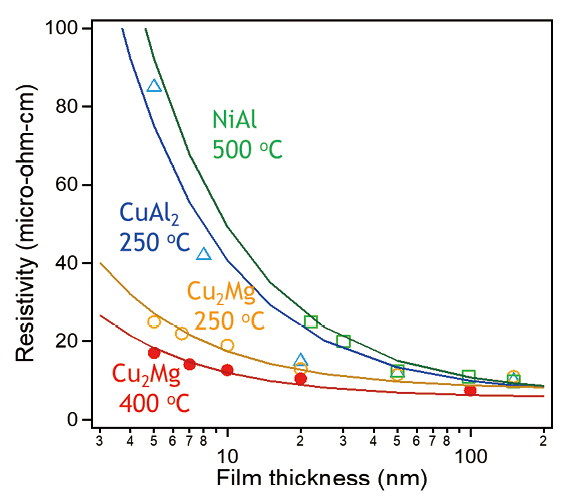
Electrical resistivity of new interconnect materials which increases with decreasing film thickness. At the thickness below 10 nm, resistivity should be lower than that of Cu.