![New Industry Creation Hatchery Center[NICHe]](../img/common/niche_en.svg)
Understanding and Treating Sarcopenia
 Specially Appointed ProfessorHideo Higuchi
Research Overview
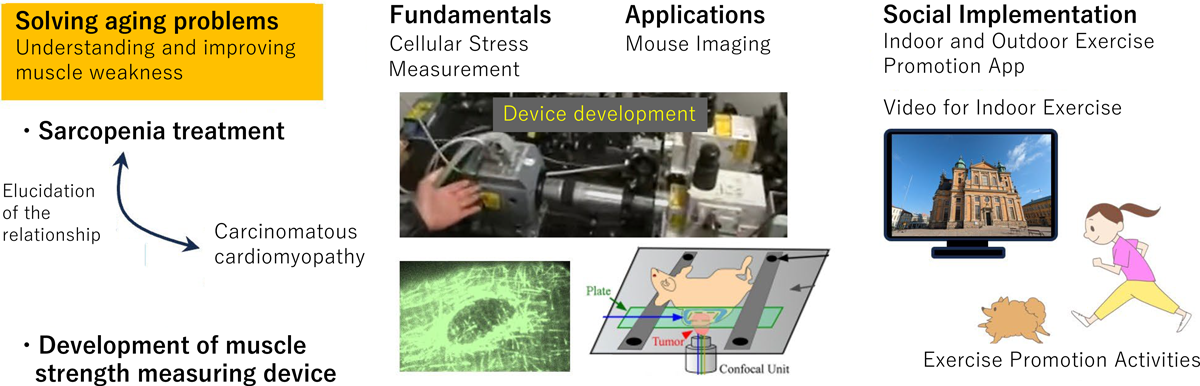
Older adults and people with health conditions have reduced walking speeds (less than 1 m/s) and have a high risk of falling due to decreased muscle strength and muscle mass that is called sarcopenia. Sarcopenia has become public health concern in Japan due to its rapidly aging population. This project aims to understand how sarcopenia occurs and to develop optimal prevention and treatment methods. Because sarcopenia is often observed in cancer patients and cardiomyopathy patients, we will clarify the relationship between these two factors and develop interventions to mitigate sarcopenia.
Research Features
Research to understand and treat sarcopenia will be conducted in the following three phases:
- Basic research: We are developing a technology to non-invasively quantify muscle weakness and cellular damage. Using this technology, cellular stresses can be applied to quantify muscle weakness and cell damage.
- Medical application research: Because reactive oxygen species (ROS) are known to cause muscle deterioration, we will administer a drug that decreases ROS to mice and verify whether it is effective in preventing damage. Furthermore, we will develop countermeasures against the causes of muscle damage identified in (1) above.
- Social implementation: A simple way to prevent sarcopenia is to perform full-body exercise. We will build a system that allows people to enjoy and efficiently exercise both indoors and outdoors to prevent muscle weakness.
Expected Outcomes and Developments
Most sarcopenia can be prevented to some extent through whole-body exercise. However, there are many unknowns regarding the causes of muscle weakness due to aging, so we will clarify the causes through basic research. Furthermore, through the development of countermeasures, we will not only contribute to basic medical science and bioengineering, but also improve the quality of life (QOL).
Sarcopenia is known to occur frequently in patients with cancer and cardiomyopathy. Through this project, we will understand the direct relationship linking these diseases and sarcopenia at the molecular level. We then aim to improve the quality of life by improving care during and after disease treatment.
Along with sarcopenia, frailty (physical frailty) and locomo (loss of motor function) are other sides of muscle weakness, and more than 40 million people in Japan alone exhibit these motor dysfunctions. Developing effective improvement methods for the population will not only improve the quality of life of people, but also will have a tremendous impact on the economy.