![New Industry Creation Hatchery Center[NICHe]](../img/common/niche_en.svg)
Development of Environmentally Sustainable Devices with Combined Mechanical and Electrical Properties
 Specially Appointed ProfessorToshiyuki Hashida
Research Overview
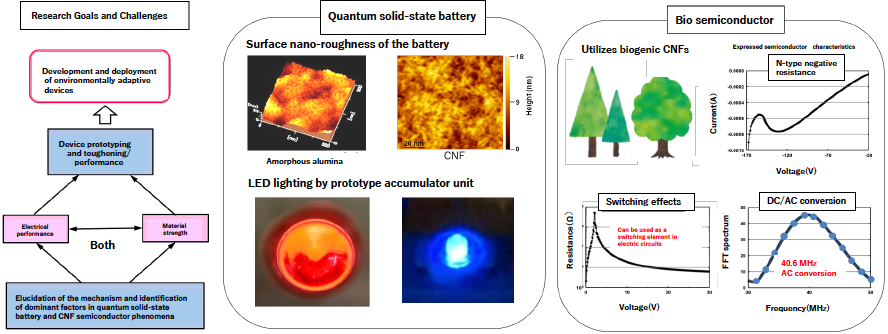
We are developing “quantum solid-state batteries” using surface nano-convexity and “bio-semiconductors” based on cellulose nanofibers (CNFs), aiming to apply these devices to the energy and electronics fields. These devices are taking advantage of the principles and phenomena discovered by Fukuhara et al. (1.2)
Research Features
Quantum solid-state batteries and bio-semiconductors are fabricated from aluminum and CNFs. Aluminum is a resource that is ubiquitous, widely available, and has a proven track record in recycling. CNF is a natural material derived from living organisms and is expected to be carbon neutral. Thus, the materials expected to contribute to the reduction of environmental impact compared to conventional technologies in terms of natural resources. In addition, from the viewpoint of appropriate use of resources, the development of devices with sufficient durability and mechanical reliability to enable long-term use is expected to contribute to the provision of environmentally sustainable technologies. Furthermore, this research aims to commercialize technologies based on new principles and phenomena, and is unique in the sense that it aims to create new industries while taking the environment into consideration.
Expected Outcomes and Developments
Quantum solid-state batteries use electrons as the medium for charge transfer, and are expected to be developed as supercapacitors capable of high-speed and high-voltage charging, overcoming the problems of conventional rechargeable batteries that use ions as the medium. The supercapacitors are expected to be used not only for storing natural and renewable energy, but also for emergency power sources in response to disasters and for lightweight mobile devices. As a result of research into bio-semiconductors, it is possible to create diodes and transistors composed of CNFs, which are expected to be applied in low-cost, high-energy-efficiency semiconductor devices. CNFs also have good biocompatibility and could be used in medical applications such as health monitoring. Because CNFs are biodegradable, they have advantages over other materials in terms of disposal and recycling. The method for achieving both electrical performance and mechanical reliability developed in this research is not limited to such devices, but is also expected to be applied to the development of devices such as solid oxide fuel cells and solid oxide electrolytic cells, which have a wide range of applications.
(1) M. Fukuhara et al., Amorphous aluminum-oxide supercapacitors, EuroPhysics Letters, 123, 58004 (2018).
(2) M. Fukuhara et al., A novel n-type semiconducting biomaterial, Sci. Rep. 12, 21899 (2022).