![New Industry Creation Hatchery Center[NICHe]](../img/common/niche_en.svg)
Supercritical Technology for Nanomaterials
 ProfessorTadafumi Adschiri
Research Overview
In the supercritical region of fluids, “water” and “oil” can be mixed uniformly. Using this phenomenon, organically modified metal oxide nanoparticles can be synthesized by reacting aqueous metal salt solutions with organic molecules under supercritical conditions. These nanoparticles can be dispersed in solvents and polymers, making it possible to fabricate hybrid materials that combine the contradictory functions of organic and inorganic materials. In this project, we are developing nanomaterial applications such as functional nano-inks and high-thermally conductive films, through an assembly process for these hybrid nanomaterials.
Research Features
The supercritical hydrothermal method is a high-speed synthesis technique for extremely small metal oxide nanoparticles. It can be applied to a wide range of metal oxides, using inexpensive raw materials, with high concentrations and high efficiency of synthesis. Furthermore, organic modification of metal oxide nanoparticles occurs in solution making it possible to join organic and inorganic species, because aqueous metal salt solutions and organic molecules are mixed at an arbitrary ratio in the supercritical state. In addition, continuous mass synthesis of nanoparticles has been realized with flow-type apparatus. In this project, a chemical engineering approach has been used to scale-up the process, and to date, a nanoparticle synthesis process of 10 tons per year has been completed. This method can also be used to synthesize novel nanocatalysts, for example, thermodynamically unstable nanocatalysts with only the crystalline surfaces exposed, which are highly catalytically active. Furthermore, highly distorted metal oxides and their new properties have been also found very recently.
Expected Outcomes and Developments
Organic-modified nanoparticles synthesized by supercritical nanomaterial technology are expected to be put to practical use as organic-inorganic hybrid materials, which are required in industrial fields such as automobiles, environmental, energy, power electronics, medicine, and construction materials. In addition, exposed surface controlled and highly active catalytic nanoparticles created by the supercritical process can be applied to new chemical schemes to contribute to energy conservation, solving the problem of depleted resources, reducing environmental impact, utilizing waste heat, and reducing CO2 emissions. Thus, we believe that supercritical nanomaterial process technology can become a new industrial technology base that will support the next generation of Japan. We will establish design methods for nanomaterials and their synthesis equipment and processes. Furthermore, by studying the structure formation of nanoparticles in hybrid materials, we will be able to design processes for hybrid nanomaterials. In this way, we aim to promote the social implementation of supercritical nanomaterials technology and ultimately make a significant contribution to industry, economy, and society.

Organic modified nanoparticles

Field of application: Hybrid polymers with ultra-high thermal conductivity
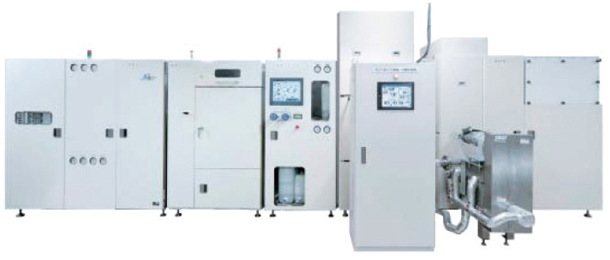
Developed supercritical hydrothermal synthesis equipment (10 t/year)